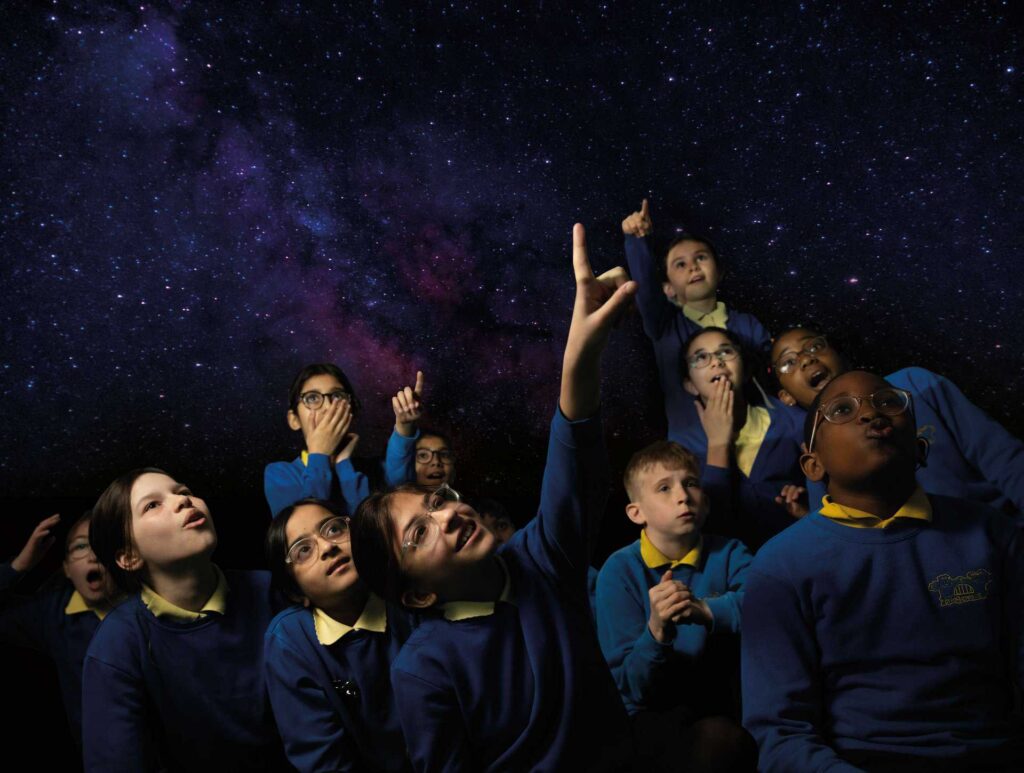
In this interactive workshop in our mobile planetarium, young people can explore planet Earth and the solar system.


Discover the movement of the Earth, its Moon and the planets in our solar system to find out how we get days and years.
A live, presenter-led planetarium experience where students can make decisions about what they discover.
In our planetarium show, students will feel like they are visiting different continents on Earth, going stargazing in Kielder and even launching a mission to the Moon. Our presenters will take you on a tour of the solar system and you will see how the JWST (James Webb Space Telescope) can help us make new discoveries about our universe.
To help our team deliver the Our Place in Space workshop safely at your school, please check that the following can be provided:
A large indoor space – such as a school hall or sports hall – to house the mobile planetarium.
-
The space should be at least 7 m × 7 m and 5 m high, with no obstructions such as projectors or theatre lights.
-
It should be accessible via a ramp or on ground level from the parking location, with no steps.
-
Access to a plug socket within the space.
Off-street parking – in the school car park, on level, even ground for safe loading and unloading.
Curriculum links
Key stage 2
Space
- KS2 Science - Earth and Space
By the end of the workshops students will have discovered:

How the Earth’s rotation leads to day and night and the apparent movement of the Sun across the sky.

The movement of Earth and other planets relative to the Sun in our solar system .

How old they would be on different planets.

The movement of the Moon relative to the Earth and why the Moon appears to change shape.

The conditions needed for stargazing and some of the constellations in our night sky.

How scientists can use the JSWT to find out more about our solar system and the universe.
Outreach prices
This workshop takes place inside our mobile Planetarium. Prices start at £360 for school visits - get in touch for a tailored quote.
Other workshops you may enjoy
Key stage 2
Space
Lunar Landers – Outreach
In this interactive workshop in our mobile planetarium, young people can explore the Moon and find the best place to build a lunar base.